Introduction
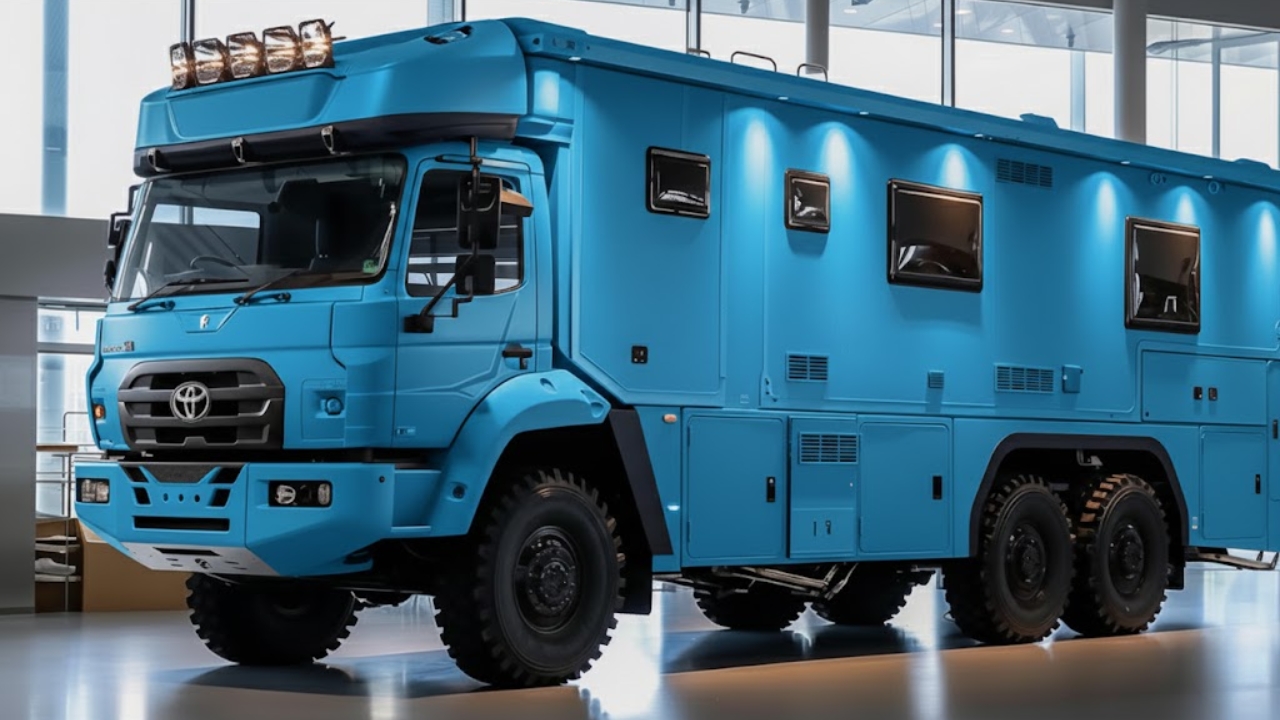
The 2026 Toyota ThunderTrek 6×6 arrives as a bold statement from a brand traditionally associated with dependable, everyday transportation. This time the Japanese automaker pushes the envelope by marrying militarised protection, off‑road wizardry and high‑end mobile‑living comforts into a single, purpose‑built platform. Targeted at seasoned overlanders, defense contractors and anyone who needs a secure foothold in remote corners of the world, the ThunderTrek 6×6 is meant to act as both a traversable fortress and a refined base‑camp on wheels.
Exterior Architecture
The vehicle’s silhouette is unmistakable. A massive, low‑slung cab sits atop a tri‑axle chassis that stretches the wheelbase to accommodate the coupled cargo modules. The hull is composed of layered composite armour that deflects small‑calibre projectiles while keeping overall weight within a manageable range. Every panel is sealed and wrapped in a noise‑dampening skin, allowing the truck to move through rugged terrain with less acoustic signature.

Key exterior traits include:
- Adaptive LED clusters that flip from daylight illumination to infrared for night‑time tactical visibility.
- Ballistic‑rated panoramic windows treated with thermal‑reflective coating to keep interior temperatures stable.
- A power‑operated side door fitted with a keypad‑controlled lock and biometric backup.
- Integrated roof‑mounted solar array, extending from the front bulkhead to the rear tailgate, capable of delivering up to 7 kW under optimal sun.
- Bead‑locked, run‑flat tires paired with a purpose‑built all‑terrain suspension that automatically levels the vehicle on uneven ground.
The overall presence feels more like a modern combat‑support vehicle than a leisure‑grade RV, yet the refined lines and careful surface treatment give it an unexpected elegance.

Cabin Layout and Living Space
Step inside and the first impression is one of purposeful luxury. The cabin is divided into three zones: a command centre, a communal living area and a private suite. All surfaces are finished in lightweight composite panels that mimic the look of natural wood while providing superior durability.
Command centre – The driver’s seat sits beneath a digital instrument cluster linked to a central touchscreen that governs power distribution, climate, security and navigation. The steering wheel carries tactile feedback buttons for rapid activation of lighting, door locks and vehicle‑wide broadcasts.
Living area – A modular lounge can be re‑configured into a dinette, a workbench or an open‑air deck when the slide‑out extensions are deployed. The seating is upholstered in breathable, antimicrobial fabric that resists wear and odor. A compact yet fully stocked galley includes an induction cooktop, dual‑zone refrigeration, a water‑filtration system and a fold‑out espresso machine.
Private suite – At the rear lies a master berth with a memory‑foam mattress, integrated storage drawers and optional climate‑controlled blanket zones. Overhead, dimmable LED strips can be programmed to simulate sunrise, sunset or any preferred colour palette.

Every surface hides concealed wiring and power ports, allowing occupants to plug in laptops, medical equipment or recreational gadgets without clutter.
Powertrain and Off‑Road Capability
Under the hood, Toyota offers two engine families: a 3.5‑litre twin‑turbo diesel delivering 440 hp and 1,300 Nm of torque, and a diesel‑hybrid variant that adds a 150 kW electric motor for an extra 150 hp of instant torque. Both configurations feed a six‑speed automatic transmission equipped with adaptive shift mapping for low‑speed crawl situations and high‑speed cruising efficiency.

The full‑time 6×6 drivetrain incorporates lockable front, centre and rear differentials, while the adaptive air‑suspension can raise the chassis up to 550 mm for obstacle clearance. A dedicated “Expedition” mode limits torque to protect the drivetrain on fragile surfaces, whereas the “Stealth” setting softens engine noise and dims external lighting.
Fuel capacity has been expanded to 400 litres, augmented by a high‑density lithium‑ion battery pack that can store up to 120 kWh. Together with the solar roof and an optional auxiliary generator, the ThunderTrek can remain off‑grid for up to two weeks without refuelling, depending on load.

Safety, Security and Surveillance
The vehicle’s defensive suite is as comprehensive as its comfort package. Ballistic‑rated windows and an alloy‑cored door protect occupants from small‑arm fire while a multilayered acoustic dampening system reduces detection by sound‑based sensors.
Electronic safety features include:
- Adaptive cruise control paired with a terrain‑aware forward‑looking radar that anticipates changes in slope and surface type.
- Lane‑keeping assist that operates in both on‑road and off‑road scenarios, correcting drift on loose gravel or sand.
- 360‑degree camera array with thermal overlay, delivering night‑vision capability to the driver’s display.
- Automatic emergency braking that can engage both on hard surfaces and on steep declines.
- A tyre‑pressure monitoring system that automatically inflates or deflates each wheel to maintain optimal contact patch.
Security can be extended with a drone‑launch module that provides perimetric scouting, a two‑way radio jammer for hostile communications and an encrypted satellite link for remote command‑and‑control.
Practical Storage and Utilities
Every cubic centimetre of the ThunderTrek has been accounted for. The rear cargo bay, accessed via a hydraulically lifted tailgate, offers 15 m³ of insulated space, capable of carrying everything from expedition gear to mission‑critical cargo. Interior sidewalls hold a series of lockable lockers, each fitted with soft‑close mechanisms and padded interiors for fragile equipment.

Utility hookups are generous: a high‑current 32 A DC outlet, three 240 V AC outlets, multiple USB‑C ports and a wireless charging pad in the central console. Water is stored in a 1,200‑litre tank, with an integrated reverse‑osmosis purifier that produces 150 litres of potable water per day. Wastewater is routed to a compact treatment module that can be emptied at service stations or dumped safely in the field.
Pricing, Availability and Customisation
Toyota has positioned the ThunderTrek 6×6 within the ultra‑premium segment. Base pricing starts at US $1.25 million, which includes the standard diesel powertrain, core armour and the basic living package. Optional upgrades—such as the hybrid powertrain, advanced surveillance drone, bespoke interior finishes or additional solar capacity—push the final price toward US $1.8 million.

Production is limited to a handful of units per quarter, each assembled at Toyota’s dedicated “Expedition Vehicle” facility in Japan. Buyers can work directly with a factory‑based design team to select colours, interior motifs and mission‑specific add‑ons, ensuring each vehicle reflects its owner’s unique requirements.
Final Assessment
The 2026 Toyota ThunderTrek 6×6 is more than a novelty; it is a convergence of military‑grade protection, rugged engineering and mobile luxury that few manufacturers can claim. Its ability to travel across deserts, snowfields, jungles and high‑altitude plateaus while preserving a comfortable, secure living environment makes it an unprecedented option for professional explorers, humanitarian organisations and private adventurers alike.

If you demand a platform that can serve as both a transport vehicle and a self‑sufficient base camp, the ThunderTrek stands out as a compelling—and arguably indispensable—choice in the emerging market for extreme‑mobility solutions.
Frequently Asked Questions
1. What is the expected off‑road ground clearance?
The adaptive suspension can raise the chassis to a maximum of 550 mm, providing ample clearance over rocks, sand dunes and deep water crossings.
2. Can the vehicle operate entirely on electric power?
While the hybrid model can run on electric drive for short distances (up to 40 km) at low speeds, the primary propulsion remains diesel‑based to guarantee range and reliability in remote environments.
3. How long does it take to fully charge the battery using the solar roof?
In optimal sunlight, the integrated 7 kW solar array can recharge the 120 kWh pack from 20 % to 80 % in roughly 12 hours.
4. Is it possible to add a winch or a front‑mounted recovery system?
Yes, Toyota offers a modular recovery package that includes a 12 tonne electric winch, a detachable front grille for winch cable routing and reinforced mounting points for recovery gear.
5. What warranty and after‑sales support does Toyota provide?
The ThunderTrek comes with a five‑year/100 000‑km comprehensive warranty covering powertrain, chassis and armour, plus a dedicated global support network for parts, service and software updates.
Disclaimer: The information presented above is based on publicly available data and manufacturer announcements as of the publication date. Specifications, pricing and availability are subject to change without notice. Prospective buyers should contact an authorized Toyota Expedition Vehicle dealer for the most current details.